domingo, 14 de junio de 2015

SECOND PARTIAL EVALUATION PART 1.


Student name: ________________________________________
Group: __________________     Date: _____________________

PART 1. VOCABULARY.

Instructions.
Choose the appropriate options to complete the sentences.
1. Hello Mario, ________? I´m very well, thank you
a) How do you do?
b) How are you?
c) How you are?
d) How is it?
2. What´s _________ name?
a) you
b) your
c) yours
d) you´re
3. How old are you? _________
a) I twenty
b) Me is twenty
c) I´ve twenty
d) I´m twenty
4. Is this your book? ________.
a) No, it isn´t
b) No, isn´t it
c) No, he isn´t
d) No, there isn´t
5. Where is Anna from? _______ from Rome.
a) She is
b) It is
c) Her is
d) He is
6. _________ is your address? 12, Sundown Street, Bristol.
a) How
b) Who
c) That
d) What
7. _______ name is John Smith
a) His
b) He´s
c) He
d) Her
8. Sammy __________ a doctor, he´s a teacher at the University.
a) aren´t
b) isn´t
c) doesn´t
d) not
9. Here are George and Maria. __________ are from Valencia in Spain.
a) Their
b) They
c) Them
d) This
10. Do you live in California? No, _______
a) I live
b) I do live
c) I don´t
d) I do
11. ____________ is a place where you buy medicine.
a) a bookstore
b) a restaurant
c) a dance club
d) a drugstore
12. ____________ is an insect which makes honey.
a) a bee
b) a spider
c) a crocodile
d) a fly
13. ____________ are something which is used for cutting paper.
a) litter
b) scissors
c) stocks
d) sharpener
14. ____________ is a place where you borrow books
a) a Laundromat
b) a theatre
c) a library
d) a gym
15. Which word means nearly the same as “scream”?
a) find
b) stop
c) sell
d) shout
16. Which word means nearly the same as “happy”?
a) conditions
b) disgusted
c) content
d) ambitious
17. A soldier is a man who _________.
a) catches thieves
b) paints pictures
c) helps the police
d) fights in a war
18. Wich is countable?
a) fox
b) bread
c) wood
d) flour
19. Wich verb´s past and present forms are the same?
a) play
b) cry
c) cut
d) write
20. Your aunt is your ___________
a) father´s brother
b) father´s grandson
c) father´s sister
d) mother´s brother


jueves, 11 de junio de 2015

FINAL EXERCISES

ENGLISH IV

EXERCISES.  

Name: ___________________________________ Group: _________________

Date: _______________________

 CONDITIONALS

Complete the lefts entences list with the right sentences list.

A) If I had their address…

…you wouldn´t reconized her.
B) If you had saw her…

…I would write to them.
C) If I did more exercise…

…I would lose weight.
D) If you got a job…

…it would cost over  650 pounds.
E) If you asked Janet…

…she would probably give you a lift.
F) If I travelled first class…

…she would give you some medicine.
G) If it was better weather…

…she would be more popular.
H) If she didn´t complain so much…

…you would have more money.
I) If you went to the doctor…

I woud probably learn French.
J) If I worked in Paris…

…we would go with you.


 Complete de following sentences with the Present Perfect Tense.

1) ___________ you ___________ (be) to Asia?

2) She __________________ (not / study) for the exam.

3) Adam and Natalie ________________ (live) together for 3 years.

4) Where ___________ he ____________ (go)?

5) We __________________ (not / leave) yet.

6) I __________________ (want) a new car for a long time.

7) ______________ the bus (arrive) ____________ yet?

8) They _____________ (bring) their children with them.


Complete de following sentences with the Past Perfect Tense.

9) When I arrived at the cinema, the film __________________ (started).

10) She __________________ (live) in China before she went to Thailand.

11) After they ________________  (eat) the sellfish, they began to feel sick.

12) If you ____________________ (listen9 to me, you would have got the job.

13) Julie didn´t arrive until after I _______________ (leave).

14) When we __________________ (finish) dinner, we went out.

15) The garden was dead because it ___________________ (be) dry all summer.

16) He _________________ (meet) her somewhere before.


Read the follow reading and write the main idea and the reading purpose.


SMARTPHONES ARE ADDICTIVE AND SHOULD CARRY HEALTH WARNING, SAY ACADEMICS

University of Derby finds smart phone users in study spent average 3.6 hours a day on devices, often causing severe distraction from relationships and ‘real life’

Smart phones are psychologically addictive, encourage narcissistic tendencies and should come with a health warning, researchers have said.
A study by the University of Derby and published in the International Journal of Cyber Behaviour, Psychology and Learning found that 13% of participants in the study were addicted, with the average users pending 3.6 hours per day on their device.
The majority of participants said their smart phone use caused distraction from many aspects of their lives, including employment, hobbies and studies.
“People need to know the potential addictive properties of new technologies,” he said. “It [the warning] could be before they purchase them or before they download an app. If you’re downloading a game such as Candy Crush or Flappy Bird there could be a warning saying that you could end up playing this for hours and you have other responsibilities [that could be neglected].”

Narcissism and neuroticism were linked to addiction and the authors suggest that smart phones can actually create the former in users. They point to the fact that 35% of people said they used their devices in areas or situations when they were banned (eg while driving), with many offering the justification that they knew better than the authorities who created the rules.

“Narcissism is a negative personality trait and if a person is spending a lot of time on Facebook or Twitter they’re more likely to display these types of traits,” said Hussain.

Hussain said that he is not anti-smart phones – he has one himself, which he uses mainly in the morning while having breakfast and in the evenings – but that addiction to them is negative.
The study says: “If adverse effects of smart phones are well advertised, users might realize that despite using the device for improving communications, it can easily lead to narcissistic actions which can potentially break down familial relationships.”
Hussain said he intends to carry out more research on the subject in future, with a more diverse sample of people.

domingo, 17 de mayo de 2015

SECOND CONDITIONAL Exercises

Read and answer the Second Conditional exercises below. 


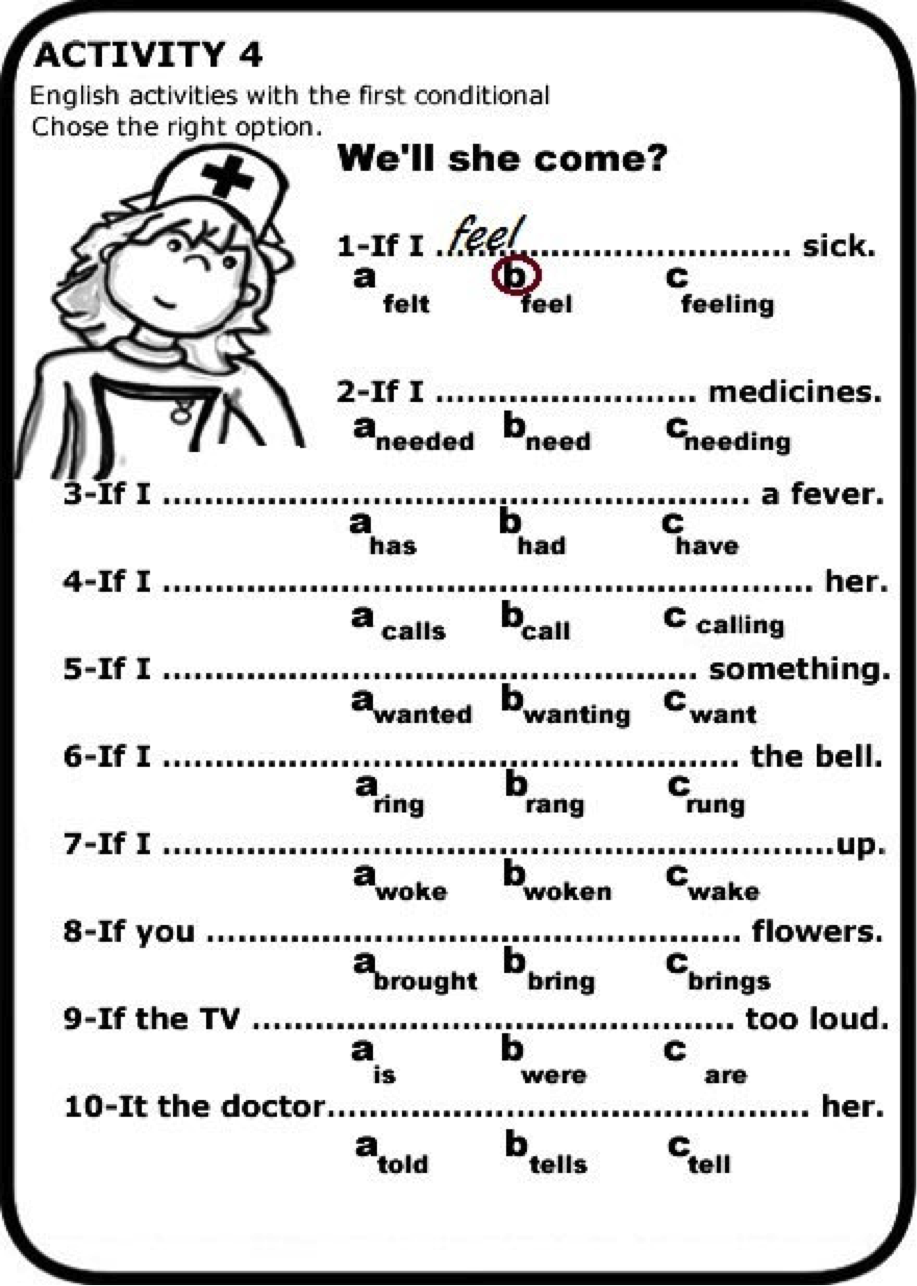
FIRST CONDITIONAL Exercises

Read and answer each First Conditional exercise on your notebook.


PRESENT PERFECT Exercises

Read and answer each Present Perfect exercise on your notebook.


PRESENT PERFECT

We use the Present Perfect to talk about the past but they are important in the present.


Form (forma):

Subject
Auxiliary
Short Form
Past Participle
I, You, We, They
have
I've, you've, we've, they've
talked, learned, traveled...
He, She, It
has
he's, she's, it's
talked, learned, traveled...


Sample (ejemplo):

Affirmative   
Interrogative   
Negative   
I have eaten.
Have I eaten?
I have not eaten.
You have eaten.
Have you eaten?
You have not eaten.
He/She/It has eaten.
Has he/she/it eaten?
He/She/It has not eaten.
We have eaten.
Have we eaten?
We have not eaten.
You have eaten.
Have you eaten?
You have not eaten.
They have eaten.
Have they eaten?
They have not eaten.

miércoles, 13 de mayo de 2015

READINGS

Reading 1.

Read the follow texts and answer the questions below on your notebook.


What is Tic?
A tic is a repeated, impulsive action, reflexive in nature, which the actor feels powerless to control or avoid. Only when the individual performs the tic, is tension and anxiety released within the individual with a tic disorder. Tics can be triggered by an emotional state or sensation, or can happen for no obvious reason. General types of tics include verbal tics, facial tics, and other muscular tics. Physical and psychological therapy and medication can cause tics to go away, often permanently. Muscular tics look something like twitches or quick grimaces, and often affect the eyes and hands. Muscular tics can affect multiple muscles at once. Some forms of stuttering are caused by muscular tics in the throat, tongue, or vocal cords when speaking or preparing to speak. 
Principio del formulario
1. According to the reading, tics ----.
A) are nothing to be fearful of
B) are not voluntary movements and they can't be consciously controlled
C) can be stopped voluntarily for brief periods
D) do not need particular treatment
E) can be triggered by the use of medicinal drugs

2. As it is pointed out in the passage ----.
A) there is usually no need to see the health care provider for a tic
B) a tic can involve only one muscle at a time
C) people with tics often feel relief after the tic is over
D) drugs used to treat tics have a low rate of success
E) the most common cause of a tic is anxiety


3. One can infer from the passage that ----.
A) anxiety can be a side effect of medication to treat tics
B) the cause may be harder to detect in the case of a facial tic
C) most tics are mild and hardly noticeable
D) although tics are involuntary, the urge sometimes can be suppressed
        for short periods with voluntary effort
E) psychological support may be helpful for those with tics


Reading 2.

Fish and chips.


"Fish and chips" is deep-fried fish in batter with deep-fried potatoes, and a popular take-away food. Fish and chips is originally from the United Kingdom, but also very popular in Australia, Canada, Ireland, New Zealand, South Africa and some coastal towns of the Netherlands and Norway; and also increasingly so in the United States and elsewhere. For decades it was the dominant (if not the only) take-away food in the United Kingdom.

The fried potatoes are called chips in British and international usage; and while American English calls them french fries, the combination is still called "fish and chips". (Potato chips, an American innovation, are a different potato-derived food, and are known as crisps in the United Kingdom.)

Fish and chips have separately been eaten for many years – though the potato was not introduced to Europe until the 17th century. The originally Sephardi dish Pescado frito, or deep-fried fish, came to Netherlands and England with the Spanish and Portuguese Jews in the 17th and 18th centuries.

The dish became popular in more widespread circles in London and the south-east in the middle of the 19th century (Charles Dickens mentions a "fried fish warehouse" in Oliver Twist) whilst in the north of England a trade in deep-fried "chipped" potatoes developed.

It is unclear when and where these two trades were merged to become the fish and chip shop industry we know today. The first combined fish and chip shop was probably the one opened in London by Joseph Malin in 1860.

During World War II, fish and chips were one of the few foods that were not rationed in the UK.


Questions about the text.

1. Fish and chips are popular only in England.
True
False
We don´t know

2. Americans call "French fries" what British call "chips".
True
False
We don´t know

3. American call "chips" what British call "crisps".
True
False
We don´t know

4. The potatoe was introduced to Europe in the 18th century.
True
False
We don´t know

5. The dish became popular in the 19th century.
True
False
We don´t know

6. The first fish and chip shop was opened in the 19th century.
True
False
We don´t know

7. Fish and chips were not eaten during World War II.
True
False
We don´t know